
The Strudel and the Pie

On travel, connection, and what Édouard Charton almost got right

Having departed the previous day from Naples, our steamship, the Etna, swiftly approaches the coasts of Sicily. Palermo lies before us. Through the pure transparency of the atmosphere, we behold the capital of Sicily gracefully unfurling at the depths of its rounded gulf. The rays of the rising sun glide over the tangled mass of houses, gilding the church steeples and the pavilions of palaces. In the distant bluish haze, indistinct mountains appear, while to the west, Mount Pellegrino stands.
You felt it, didn't you. The light. The water. The pull.
That passage was printed in 1860. It appeared in a French magazine called Le Tour du Monde — The Tour of the World — founded by a publisher named Édouard Charton. Every two weeks for fifty-four years, without interruption, he sent his readers somewhere they had never been. Wood engravings of the Himalayas. A family in Indochina. A market in Marrakech. A fishing village in Patagonia rendered in such careful detail you could almost smell the water. For a few francs, the world arrived at your door.
Charton was not primarily a businessman. He was a Saint-Simonian idealist, a republican, a man who believed with quiet ferocity that if ordinary people could see the world — really see it — they would find it impossible to hate one another.
The last issue arrived in July 1914. The guns of August followed days later.
To understand what Charton was attempting, you have to understand what he understood about us. Humans do not merely travel. We want to travel, and that wanting is something older and stranger than curiosity. At the neurological level, novelty triggers dopamine — the brain rewards exploration the way it rewards eating or falling in love. We are, by design, restless. Those among our ancestors who wandered found new resources, new shelter, new possibilities. The wanting kept our species moving and expanding its understanding of the world.
But under the biology is something more interior. Travel strips away the fixed self. At home, you are layered in history — the person your family remembers, the colleague of ten years, the reputation on the street. In a foreign place, all of that falls away. You become, briefly, only what you are in the present moment. And beneath even that is the oldest hunger: to belong not just to a neighborhood or a nation, but to the species itself. To look across a table at someone whose language you do not speak and feel, with your whole body, that the distance between you is a fiction.
Charton felt all of this. He was a publisher of genius because he understood that the desire to travel was really a desire to connect, and that it lived in nearly every human being whether they could afford a ticket or not. His magazine was the solution: armchair travel for the masses, the world delivered to your door. He was not selling entertainment. He was selling the dream of a human family.
Here is what he got wrong.
The engraving of a family in Indochina is not a family in Indochina. It is a beautiful, careful, respectful picture of one. The reader who spent a winter evening with that image felt something real — curiosity, warmth, wonder, a loosening of the provincial self. But when the magazine was closed and set on the shelf, the family closed with it. They returned to being abstract. And abstractions, however beautifully rendered, cannot withstand a newspaper headline, a politician's speech, a single season of fear.
Charton's magazine taught Europeans to gaze at the world with open eyes. What it could not do was make the world real to them — present, particular, personal, and therefore defensible. He fed the hunger for connection without ever quite satisfying it. And a hunger that is perpetually fed but never satisfied does not go away. It waits.
In 1914, it was answered by something else entirely.
Now imagine a different story.
A German family moves in next door. He speaks no English. But the second morning, he appears at your door holding an apple strudel. You receive it. You smile, you gesture, you mime your gratitude with the elaborate sincerity of two people who have nothing but goodwill and no common words. The next day you bring him an American apple pie. He laughs, and so do you. There is no punchline — the laughter is the punchline, the shared recognition that two people just said something true to each other without language. The children find each other without being introduced. Before long, you are sitting together in the same pew. Seasons pass. You learn words of each other's language. You learn the name of his mother and he learns the name of yours.
Then someone tells you he is dangerous. That he is responsible for the problems in your life. That you would be better off without him.
And you say: Not him. I know him.
That sentence is a fortress. It cannot be built from an engraving. It cannot be assembled from a magazine, a documentary, a social media account, or a thousand miles of good intentions. It can only be built from the strudel and the pie, from the children running between yards, from the years of ordinary proximity that make another person real to you in the way that makes their dehumanization literally unthinkable.
This is what was missing in 1914. Not knowledge of the world. Europe was drowning in knowledge of the world. What was missing was the neighbor. The real one. The one whose mother's name you know.
Think about what that sentence — not him, I know him — would have meant in 1939. In Germany. In Poland. In Amsterdam. Think about how many times it was said, and by whom, and at what cost. Think about how many times it was never said because the strudel was never baked, because the pie was never brought, because the years of ordinary proximity never happened.
The desire to travel is the desire for that sentence. It always has been. Charton knew it. He built the most beautiful machine in publishing history to try to manufacture it at scale. And the machine was magnificent, and it was not enough, because you cannot manufacture the real thing. You can only go and make it.
So here is what travel is for.
Not the collection of places. Not the photographs. Not the growth, or the awe, or the escape, though it can be all of those things on the way to what it actually is. Travel is the practice of turning strangers into neighbors. It is the only mass-scale mechanism humans have ever developed for building the specific kind of knowledge — personal, particular, irreducible — that makes another person real enough to defend.
Charton was right about the desire. He was right about what it pointed toward. He just stopped one step short. He gave us the engraving when what we needed was the door.
Go knock on it. Bring something to share. Stay long enough that someone learns your mother's name.
That is what travel is for. That is what it has always been for. And in the right moment, in the right doorway, it is the only thing that has ever been enough.
Randall Self is the owner of Amerigo Travel, an independent agency within the Avoya Travel Network specializing in European cultural travel and river and ocean cruising. amerigotravel.co | Navigate with Purpose.
Go deeper than the postcard. One essay a month on the places, history, and stories most travelers miss.

Cha elle de Sainte-Rosalie, pres Palerme - Le Tour du Monde, 1860. Public domain. 
Rocher de Scylla- Le Tour du Monde, 1860. Public domain. 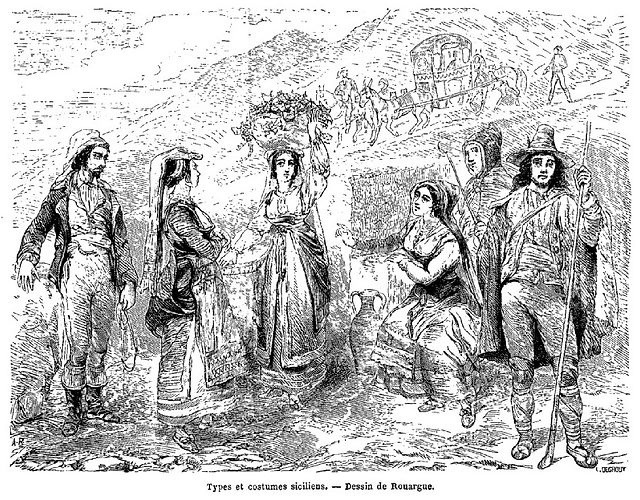
Types et costumes siciliens - Le Tour du Monde, 1860. Public domain. 
Vue de Syracuse - Le Tour du Monde, 1860. Public domain. 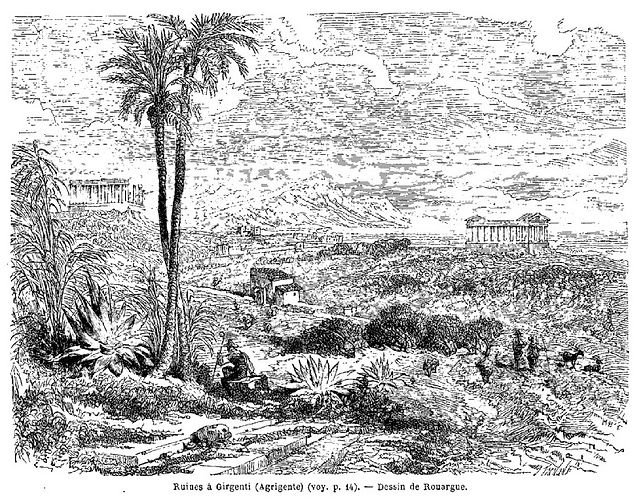
Ruines a Girgenti - Le Tour du Monde, 1860. Public domain. 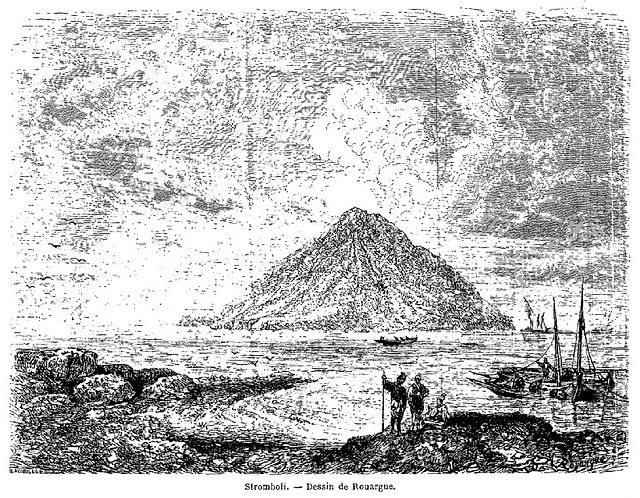
Stromboli - Le Tour du Monde, 1860. Public domain.


